











On a busy New York block, you usually get a second or two to catch attention. That is where custom advertising flags NYC businesses rely on can do work that flat signs sometimes cannot. They move, they rise above sidewalk clutter, and they help people spot a storefront, booth, check-in table, or promotion before they pass it.
For businesses, event teams, and exhibitors, flags are not just decorative. They are directional, promotional, and practical. The right flag setup can help pull walk-in traffic from half a block away, mark an entrance at a street fair, or make a trade show footprint easier to find in a crowded room. In a market like New York, where visibility and speed matter, that makes flags a useful part of the display mix.
Why custom advertising flags work in NYC
New York is visually crowded. Storefront signs compete with awnings, bus shelters, construction barriers, parked vehicles, and constant foot traffic. A flag works differently because it adds height and motion. That extra movement helps draw the eye without needing a massive footprint.
This is especially useful for businesses that depend on immediate recognition. A retail shop can use a flag to highlight a sale near the curb. A real estate team can mark an open house entrance. A food vendor can make its line easier to find during a busy event. At expos and community activations, flags help separate one setup from the next when every booth is trying to get noticed.
There is also a speed advantage. Compared with larger custom structures, flags are relatively fast to produce, easier to transport, and simpler to set up. That matters when an event date is close or a promotion came together late.
Choosing the right custom advertising flags in NYC
Not every flag format fits every location. In practice, the best option depends on where it will be displayed, how much room you have, and whether the goal is branding, wayfinding, or direct promotion.
Feather flags for sidewalk and event visibility
Feather flags are one of the most common choices because they are tall, narrow, and readable from a distance. They work well outside retail locations, at curbside activations, and near event entrances. If you need strong brand recognition with a simple message like Grand Opening, Open House, Sale, or Check-In, feather flags are often the most straightforward pick.
Their shape also helps when sidewalk space is limited. In many NYC settings, that matters more than people expect.
Teardrop flags for tighter spaces
Teardrop flags hold their shape well and are useful when you want a more compact display. They are common at indoor events, sports activations, and controlled outdoor setups where a cleaner, contained shape looks better than a taller vertical profile.
They usually show less copy than a feather flag, so they are better for logos, short calls to action, and simple directional messaging.
Straight flags for cleaner branding
Straight flags offer a more structured look and can be a good fit for corporate events, trade show environments, and promotional spaces where brand presentation needs to feel polished. They can carry a larger graphic field, which helps if your design depends on a clear logo lockup or a stronger visual layout.
The trade-off is that they need enough space to display properly. On a narrow sidewalk or in a heavily packed venue, another format may perform better.
Design matters more than most buyers think
A flag is not a brochure. People are usually seeing it while walking, driving, or scanning a room. If the design is overloaded, the flag may be technically printed well but still fail in real use.
For most custom advertising flags NYC locations call for, short messaging wins. Your logo, one clear offer or category, and high-contrast color are usually enough. If the flag is meant to guide people, use words that are instantly understood, like Entrance, Registration, Leasing Office, Open, or Samples Here.
Typography needs extra attention. Thin fonts and long taglines tend to disappear at distance. Bold, simple type reads faster. The same goes for color choices. A strong contrast between background and text usually performs better than subtle brand palettes, especially outdoors.
Artwork setup also affects production quality. Files should be sized correctly for the flag shape, with key content kept inside the safe area. What looks centered on a rectangular proof may not look centered once it is placed on a curved flag template. That is a common issue on rush jobs.
Indoor vs. outdoor use changes the hardware choice
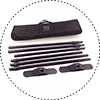
The print is only one part of the order. The base and pole matter just as much because they affect stability, portability, and where the flag can actually be used.
For indoor events, a flat metal base often works well on hard flooring. It keeps the footprint manageable and gives the display a cleaner look for trade shows, lobbies, and registration areas. For outdoor setups, heavier cross bases, spike bases, or weighted options are usually the better move depending on the surface.
This is where New York conditions make planning more specific. A flag for a convention center floor is not the same as a flag for a sidewalk sale in Manhattan or a street festival in Queens. Wind exposure, pavement type, pedestrian flow, and available clearance all affect what hardware makes sense. If the setup is temporary and mobile, lighter hardware may help. If it needs to stay put through a long event day, extra weight is usually worth it.
Who typically uses advertising flags in the city
Flags fit a wide range of local use cases because they solve a basic problem: getting noticed fast.
Retail operators use them to call out promotions, seasonal inventory, and street-level offers. Real estate teams use them for open houses, leasing events, and property branding. Event planners use them for entry points, sponsor recognition, and crowd direction. Trade show exhibitors use them to add vertical branding without building a larger booth. Schools, nonprofits, and community groups use them at outreach events where visibility needs to be quick and affordable.
For restaurants and food businesses, flags can also help identify pickup zones, soft openings, and outdoor activations. In each case, the value is less about decoration and more about helping people locate, identify, and respond.
When same-day turnaround actually matters
A lot of print products are ordered in advance. Flags are often different. They tend to come into play when an event gets approved late, weather changes an outdoor plan, or a business realizes at the last minute that its setup needs more visibility.
That is why local production matters. If you are ordering custom advertising flags in NYC for an event this week, waiting on a distant online printer can create unnecessary risk. File fixes, proof timing, pickup coordination, and hardware availability all move faster when the job is handled locally.
This is one reason businesses working under tight deadlines often choose a New York provider with broad display inventory rather than trying to source print and hardware from separate vendors. It cuts down on delays and reduces the chances of discovering too late that the base, pole, or finish was not included.
Pairing flags with other display products
Flags work best when they are part of a larger visual setup. A flag can attract attention from a distance, but it usually performs better when paired with signage that closes the message at eye level.
For a storefront, that might mean a flag outside and a vinyl banner in the window. At an expo, it could mean a branded flag beside a retractable banner stand or table throw. For outdoor promotions, a flag can support a tent, backdrop, or rigid sign by marking the space from farther away.
This is where a practical print plan makes a difference. You do not always need a large, expensive buildout. You need the right mix of products for the way people move through the space.
What to check before placing the order
Before production starts, confirm the display location, the flag style, the base type, and the key message. If the flag is going outdoors, think honestly about wind and surface conditions. If it is going indoors, make sure the height works under venue restrictions. If it needs to travel between events, portability may matter more than maximum size.
Also check the artwork for readability at distance. A good rule is simple: if the message cannot be understood in a quick glance, it probably needs to be reduced. Flags are a high-visibility format, but only when the graphic is built for fast viewing.
For buyers on a deadline, it also helps to work with a local shop that understands event pressure and can turn around matching products if the order expands. Print Banners NYC serves that need for businesses that want flags, banners, and display graphics produced fast in one place.
A well-made flag will not fix weak branding or a poor event setup, but it can make your business easier to find and harder to miss. In a city where attention moves fast, that is often exactly the job the display needs to do.