











A display that looks great on screen can still fail at an event if it is too small to read, placed at the wrong height, or delivered without the hardware needed to install it. This guide to event display printing is built for NYC businesses, exhibitors, planners, and marketing teams that need visible, event-ready graphics without wasting time or budget.
Start With the Job Your Display Must Do
Do not begin by choosing a product name. Start with where the display will sit and what attendees need to do after seeing it. A storefront promotion needs fast readability from the sidewalk. A trade show booth needs branding that works from several aisles away. A press wall needs a clean, repeatable logo pattern for photos. A directional sign needs to move people quickly through a busy venue.
One event can require several display types because each has a different job. A step-and-repeat backdrop creates a branded photo area, while a retractable banner stand explains the offer. Table throws cover standard event tables with full-color branding, and rigid signs handle schedules, pricing, wayfinding, or sponsor recognition.
Before ordering, define the viewing distance, placement, indoor or outdoor conditions, setup time, and whether the display will be reused. These details determine the right size, material, finishing, and hardware. They also prevent a common last-minute problem: ordering attractive graphics that do not fit the space or function at the venue.
Choose the Right Event Display Printing Format
Banners for flexible, high-visibility messaging
Vinyl banners are a practical choice for entrances, retail promotions, sponsor recognition, event announcements, and temporary branding. They can be produced in a wide range of sizes and finished with grommets, hems, pole pockets, or other mounting options. The finishing matters as much as the print. A banner intended for a fence needs a different setup than one hanging behind a registration desk.
For outdoor use, plan for wind, mounting points, and exposure time. Mesh material can reduce wind resistance in some locations, while standard vinyl gives stronger color and coverage when conditions are controlled. Ask yourself how the banner will be secured, not just where it will be seen.
Banner stands for portable presentations
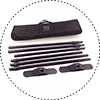
Retractable banner stands are made for speed. They travel in a carrying case, set up in minutes, and keep the graphic tensioned without wall mounting. They work well at conferences, leasing offices, sales presentations, recruiting events, lobby activations, and pop-up promotions.
Use a banner stand when the message needs to be portable and repeatable. Keep the primary headline in the upper half of the graphic, where it remains visible even when people gather in front of it. Avoid treating it like a flyer. One clear message, a strong visual, and a direct call to action will outperform a crowded layout.
Backdrops, booths, and SEG displays for branded spaces
If the event includes a photo opportunity, media area, sponsor wall, or full exhibit footprint, a backdrop or trade show display gives the brand more presence. Step-and-repeat backdrops are designed for logo visibility in photography. Trade show booths and fabric display systems create a more complete branded environment. SEG displays use silicone-edge graphics fitted into a frame for a clean, tailored look, while lightboxes add illumination where venue lighting is weak or competition is heavy.
These formats involve more planning because dimensions, frame compatibility, packaging, and installation all matter. They are worth it when the display will be used repeatedly or when the event is a major sales, media, or brand-building moment.
Signs, decals, flags, and table displays for the details
The smaller pieces often keep an event organized. Rigid signs are useful for check-in instructions, menus, real estate open houses, schedules, pricing, reserved areas, and directional messaging. Floor decals and wall graphics can guide traffic without adding another stand. Flags add movement and height outdoors, while branded table throws make a simple check-in or demo table look established.
A strong event setup usually combines one high-impact visual with supporting signs that answer practical questions. Where do I go? What is being offered? Who is sponsoring this? How do I take the next step?
Design for Distance, Not Just for Approval
Event graphics have seconds to work. The person approving a proof may be viewing it on a laptop from two feet away. Attendees may see the finished display from 10, 20, or 50 feet away, often while walking past it.
Build the design around a clear hierarchy. Your logo should be recognizable, but it does not need to be the largest object on every display. Give the main message the most visual weight, then support it with a short benefit, date, location, offer, QR code, or contact detail. If every element is large, nothing is prioritized.
Use high-contrast color combinations and type that remains readable at a distance. Thin fonts, pale text on a light background, and long paragraphs are frequent problems. A QR code can be useful, but it should be large enough to scan and placed where visitors can safely stop. For a busy aisle or sidewalk, include a short URL or clear contact method as backup.
Photography must be high resolution at the final print size. A small image pulled from social media may look acceptable in a proof but turn soft or pixelated on a large banner. Vector files are preferred for logos, icons, and type because they scale cleanly. If you are supplying a PDF, confirm that fonts are embedded and that the file is sized correctly for the final display.
Plan Production Around the Event Schedule
A same-day print need is common in New York, especially when event details change, shipments are delayed, or a team realizes a key graphic is missing. Fast production can save the event, but it works best when the order information is complete from the start.
Provide final dimensions, quantity, material, finishing, artwork, and required deadline at the time of order. Also state whether you need stands, frames, bases, carrying cases, grommets, or installation accessories. A printed banner is not automatically ready to hang, and a fabric graphic is not useful without the compatible frame.
Leave time for proof approval, venue delivery rules, elevator access, loading dock hours, and setup. Many NYC venues have specific receiving procedures, restricted installation windows, or requirements for fire-rated materials. If the display is going to a hotel, convention center, office tower, or public event space, confirm those rules before production.
For urgent jobs, simplify where possible. Standard sizes, established hardware, print-ready files, and straightforward finishing usually move faster than custom fabrication. That does not mean settling for poor presentation. It means choosing the fastest format that still meets the display goal.
Build a Display Package Instead of Ordering One Piece at a Time
Treat the event as a physical customer journey. What does someone see from afar? What confirms they are in the right place? What explains the offer? What remains visible in photos?
For many small business events, a practical package may include a branded backdrop or banner stand for visibility, a table throw at check-in, and rigid signs for directions or pricing. A trade show exhibitor may need a booth backdrop, two retractable banners, a counter graphic, and printed collateral. A real estate team may pair open-house signs with window decals, directional arrows, and a branded banner.
The right package depends on budget, venue rules, audience flow, and reuse plans. A one-night fundraiser may prioritize a photo backdrop and sponsor signs. A company attending several expos may spend more on durable hardware and replaceable graphics. Buying with reuse in mind can lower the cost of future events, but only if the messaging is not tied too tightly to one date or campaign.
Final Checks Before You Send Artwork
A quick preflight review prevents expensive corrections when the deadline is already tight. Confirm these items before production:
- Final display size and orientation
- Bleed, safe margins, and the location of hems, grommets, or pole pockets
- High-resolution images and vector logos where available
- Correct phone numbers, URLs, dates, addresses, and QR codes
- Hardware, bases, frames, and installation accessories needed on site
For event graphics that need to work under real deadline pressure, choose the format based on the venue, make the message readable at a glance, and order every piece needed for setup. Print Banners NYC can help turn a complete event display plan into banners, signs, backdrops, booths, and supporting graphics ready for the room. The best time to solve an event display problem is before the doors open.