











A shopper has already made the hard decision: they walked into your store. Retail point of purchase graphics give them a reason to make the next one quickly, whether that means trying a new product, adding an item to the basket, joining a promotion, or noticing a service they came in to find.
For New York retailers, timing matters as much as design. A weekend sale, a product drop, a seasonal window change, or a last-minute brand activation cannot wait weeks for printed materials. The right graphics need to be clear at a glance, durable enough for a busy store, and produced in formats that fit where customers actually stop, browse, and pay.
What Retail Point of Purchase Graphics Do
Point of purchase, often shortened to POP, refers to visual materials placed where a customer can take action. That can be beside a register, on a checkout counter, near a shelf, in a window, at an endcap, or beside a featured display. Unlike broad brand advertising, POP signage is tied to a specific moment in the buying process.
A good POP graphic answers one immediate question: Why should I pay attention to this item right now? The answer may be a price, a limited-time offer, a product benefit, a bundle, a new arrival, or a simple directional cue. If customers need to stand still and read a paragraph to understand it, the message is doing too much.
These graphics are especially useful when staff cannot personally explain every offer. In a busy coffee shop, boutique, pharmacy, showroom, or grocery environment, printed displays keep the promotion visible even when the line is moving and employees are occupied.
Choose the Format for the Retail Space
The most effective format depends on sightlines, available floor space, traffic flow, and how long the promotion will run. A polished sign is not useful if it blocks merchandise, falls out of view, or creates clutter around a checkout area.
Countertop Signs and Small Rigid Displays
Countertop signs work well for impulse purchases, QR-driven offers, loyalty programs, service upgrades, and add-on products. Foam board, PVC, acrylic, and other rigid sign materials hold their shape and present a clean, professional face near a register or reception desk.
Keep counter messaging short. A product image, one offer, and a direct call to action typically work better than a full product catalog. For example: “Add a gift card,” “Ask about same-day delivery,” or “Buy two, save 15%.”
Posters and Window Graphics
Posters handle larger messaging without requiring permanent installation. They are a practical choice for sale announcements, new arrivals, menu changes, and product campaigns. Window posters and adhesive graphics extend that message to people walking past the store, which is valuable on high-traffic New York streets where customers may decide to enter based on a three-second glance.
For storefront windows, contrast matters more than subtle detail. Use large type, a limited color palette, and a message that can be understood from several feet away. If the window already has merchandise, decals, hours, and other notices, simplify rather than adding another crowded layer.
Floor Graphics and Directional Decals
Floor decals can lead customers toward a promotion, pickup area, fitting room, sample station, or checkout queue. They are useful when a campaign needs to guide movement instead of just attracting attention. In retail environments with high foot traffic, choose materials designed for floor use and make sure edges are applied cleanly.
Directional graphics need restraint. One clear path is helpful. Multiple arrows pointing in competing directions are not. Consider the shopper's route from entrance to featured product to checkout, then place messaging where it supports that route.
Banner Stands and Freestanding Signs
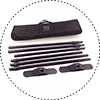
Retractable banner stands, X-banners, and rigid signs on easels are strong choices for temporary promotions, pop-up retail, in-store demonstrations, and product launches. They are easy to move, store, and reuse, making them a practical option for teams that rotate campaigns frequently.
A freestanding display earns its footprint when it can be seen before a customer reaches the product. Place it near an entrance, endcap, queue line, or event area, not in a narrow aisle where it becomes an obstacle. For a campaign that lasts only a few days, portable hardware is often more economical than a custom-built fixture.
Design Retail POP Graphics for Fast Decisions
The design job is not to fit every selling point onto one sign. It is to make the next action obvious. Start with the priority: a discount, product name, category, new arrival, benefit, or instruction. That message should be the largest element on the graphic.
Use product photography when the item itself is visually appealing or unfamiliar. Use bold typography when the offer is the main draw. A restaurant may need a high-quality image of a seasonal drink; a service counter may only need “Same-Day Pickup Available” in large, readable type.
Price deserves special attention. If the price is the offer, make it easy to spot and easy to understand. Avoid vague language such as “great value” when a concrete deal can do the work. “Three for $10” is more actionable than “multi-buy savings.”
Brand consistency still matters, but retail signage does not need to look like a corporate brochure. A small logo, familiar colors, and approved fonts can maintain the brand while allowing the promotion to lead. In a crowded store, excessive branding can bury the actual reason to buy.
Material and Finish Should Match the Job
Paper posters are cost-effective for short campaigns and frequent swaps. They work well in frames, window mounts, and protected indoor locations. For longer indoor use or signs that will be handled repeatedly, rigid boards offer a more durable option.
Vinyl is a practical material for decals, window graphics, wall messages, and certain promotional applications. It is adaptable, but the adhesive choice matters. Removable vinyl is useful for temporary campaigns and leased retail locations. Permanent adhesive makes more sense for long-term branded elements. Choosing the wrong adhesive can turn a simple update into an avoidable removal job.
Lamination may be worth considering for high-touch graphics, signs near entrances, or materials exposed to moisture and cleaning. It adds cost, so it is not necessary for every poster. For a one-day promotion indoors, a basic print may be sufficient. For a display that needs to survive weeks of handling, lamination can protect the investment.
Placement Is Where the Sale Happens
Retail POP graphics should appear where customers have enough time to notice them. That usually means the entrance, the category shelf, the product display, the fitting room approach, the service counter, and the checkout line. A sign hidden behind inventory or placed above normal eye level may technically be present but will not perform.
Think in stages. Window graphics and entrance signs bring people in. Category and shelf signage helps them find the offer. Counter signs and checkout displays encourage the final add-on. Not every promotion needs signage at every stage, but the stages reveal where a message may be missing.
Test the view from a customer's position, not from behind the counter. Stand at the entrance. Walk the aisle. Join the line. If a graphic disappears behind a display, competes with five other signs, or reads too small at the intended distance, adjust it before printing a full run.
Plan for Promotions Without Wasting Print
Retail campaigns change quickly, especially around holidays, local events, inventory shifts, and vendor promotions. Build reusable elements into the display plan where possible. A branded retractable banner stand can support rotating poster inserts or nearby changeable signs. A durable counter holder can be reused with updated print cards. Standard-sized posters make replacement fast.
For a short sale, printing a large quantity of permanent-looking signage may not be the best use of budget. For a repeated promotion, investing in stronger materials and reusable display hardware can reduce future setup time. The right answer depends on duration, location, and how often the message will change.
Before sending artwork to print, confirm the finished size, viewing distance, installation surface, deadline, and whether hardware is included. These details prevent common problems such as a sign that is too small for the wall, a decal that does not suit the surface, or a banner that arrives without the stand needed to display it.
Print Banners NYC helps local businesses prepare banners, posters, rigid signs, decals, banner stands, and other display pieces when a store promotion or retail event needs to move fast. For urgent projects, a complete production plan is better than a last-minute sign order: decide what customers need to see, where they will see it, and what format can be installed on time.
The best retail graphics do not demand attention for their own sake. They make the customer's next choice simpler, faster, and easier to act on.